Struck-by incidents cause roughly 10% of construction fatalities globally, and Saudi Arabia's giga-project scale, summer heat, and dust exposure make them the #1 day-to-day killer on sites from NEOM to Qiddiya. AI video analytics with pedestrian detection, PPE compliance checks, and forklift proximity alerts can cut struck-by incidents by 60-80% when properly tuned and integrated with site workflows.
Why struck-by incidents dominate Saudi construction sites
Struck-by incidents construction Saudi Arabia has emerged as a leading cause of serious injuries and fatalities on Vision 2030 job sites. OSHA's U.S. "Fatal Four" data puts struck-by at ~10% of construction deaths (about 200+ workers per year in the U.S.), but the proportional risk is amplified on Saudi giga-projects for three reasons: scale, speed, and environment.
- Scale: NEOM alone spans 26,500 km², Qiddiya covers 334 km², and Diriyah is rebuilding 7 km² of historic Riyadh. Each hosts 30,000-80,000 workers during peak construction, with thousands of vehicles and heavy equipment moving per shift.
- Speed: Project schedules compress 6-12 months of normal work into a single quarter. Supervisors can't physically police every intersection.
- Environment: Summer ground temperatures regularly exceed 55°C, ambient air sits at 42-50°C from May to September, and shamal dust events drop visibility below 200m several times per season. Heat stress alone slows reaction time by 10-25% according to NIOSH research, while dust obscures hi-vis PPE and equipment markings.
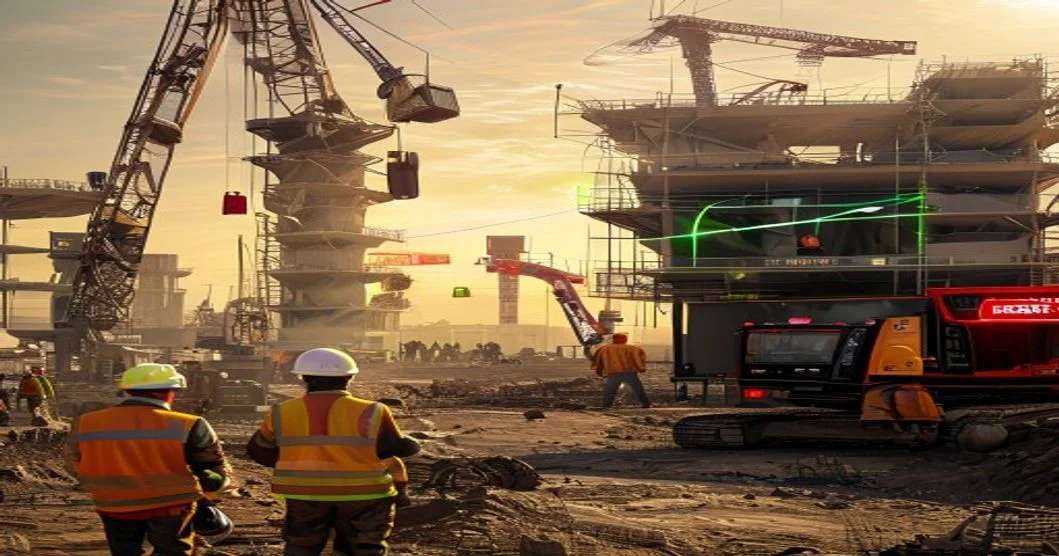
The result: a struck-by event on a Saudi mega-site can involve a 30-tonne articulated dump truck, a reversing loader, or a tower-crane load, not a 2x4 dropped from a second-floor deck.
The four most common struck-by scenarios on Saudi projects
Across Royal Commission Jubail/Yanbu, NEOM, Qiddiya, and Saudi Aramco project sites, four patterns repeat:
- Vehicle-to-pedestrian strikes. Reversing dump trucks, telehandlers, and wheel loaders hitting ground crews in blind spots. These account for ~45% of struck-by fatalities on Saudi industrial sites.
- Falling or flying objects. Tools, materials, or formwork dropped from scaffolding, decks, or crane slings. Roughly 25% of incidents.
- Equipment rollover / caught-between. Forklift tip-overs and excavator swings where a worker is pinned. ~20%.
- Vehicle-on-vehicle or wall collisions. Cranes hitting adjacent structures, trucks striking site offices. ~10%.
The remaining incidents split between rigging failures and conveyor or aggregate-plant strikes.
How AI video analytics actually stops struck-by incidents
A modern AI video analytics construction safety stack doesn't replace HSE officers; it multiplies them. Here's the working sequence, from detection to action:
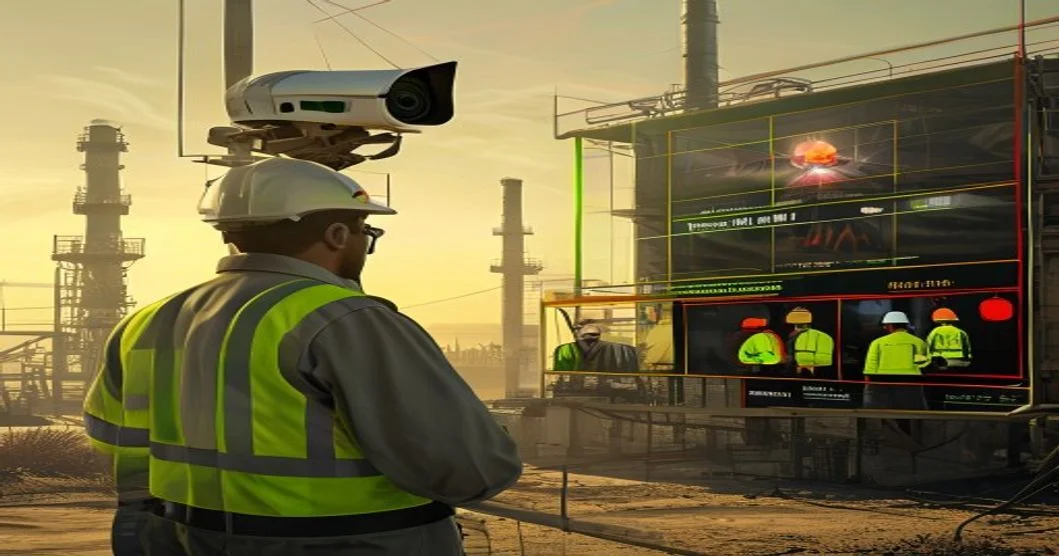
- Detect. Fixed IP cameras (4K or higher), thermal cameras for night and dust, and PTZ cameras on towers feed an edge-AI appliance running pedestrian detection construction site models.
- Classify. The model distinguishes worker from vehicle, identifies PPE (hard hat, hi-vis vest, safety boots), and flags missing PPE compliance AI violations in real time.
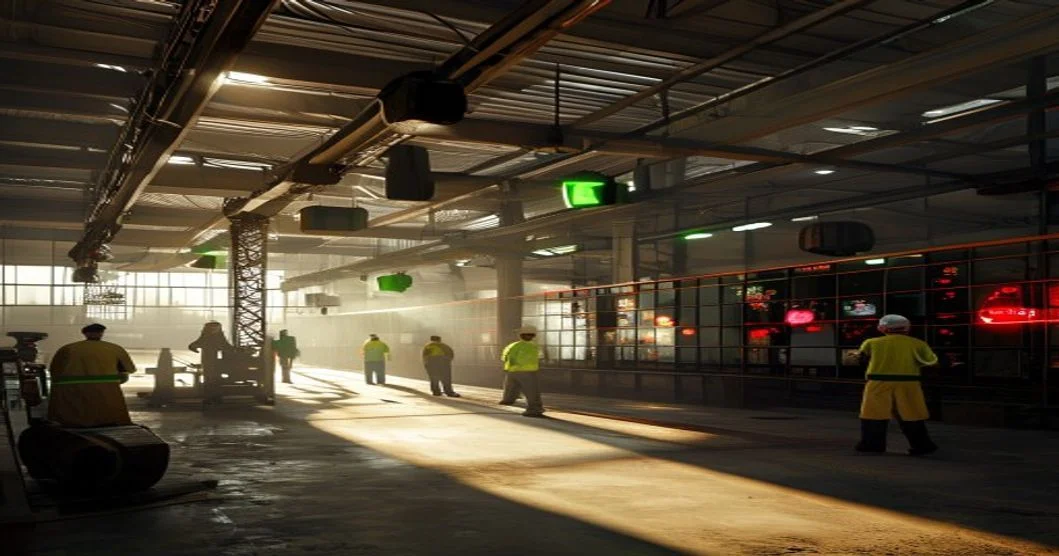
- Geofence. A software-defined polygon overlays each camera view: pedestrian-only zones, vehicle-only lanes, exclusion zones around lifting operations, and 5-15m forklift proximity alert AI camera perimeters.
- Alert. When a pedestrian crosses into a vehicle lane, or a forklift reverses inside the alert radius, the system fires a strobe, horn, SMS, and dashboard notification in under 500 ms.
- Record. The 10-second pre-event and 10-second post-event clip is archived with timestamp, GPS, camera ID, and worker badge ID (where linked) for incident review and PDPL-compliant audit.
- Learn. Weekly heatmaps show where near-misses cluster, so HSE can reroute haul roads or move exclusion zones, converting incident data into design changes.
Detection vs. prevention: what the camera stack actually does
Not every AI safety feature is preventive. Here's the honest breakdown:
| Capability | What it actually does | Stops a strike? | Saudi deployment notes |
|---|---|---|---|
| Pedestrian-in-zone detection | Alerts driver + worker when person enters vehicle lane | Yes — primary use | Needs camera height ≥6m, dust-cleaning wiper |
| Forklift proximity alert | 5-15m exclusion zone triggers horn + strobe on reversing truck | Yes — high impact | Works in low light; thermal sensor recommended for night shifts |
| PPE compliance detection | Flags missing hard hat / vest; logs violation | Partially — changes behaviour over time | Avoid facial recognition to stay PDPL-safe |
| Geofencing / no-go zones | Virtual perimeter around excavations, lifts, energised gear | Yes — physical prevention | Integrates with access-control turnstiles |
| Plate / badge recognition | Links vehicle or worker to incident clip | No — investigative only | Requires explicit consent under PDPL |
| Heat-stress posture detection | Flags workers showing heat-illness gait | Indirectly | Edge-AI only; cloud blocked under PDPL cross-border rules |
| Drone-based aerial scanning | Maps stockpile vs. worker proximity weekly | Indirectly — planning tool | Requires GACA drone permit and NOTAM filing |
The first three rows are where AI directly prevents strikes. The rest either support investigation or feed planning.
Saudi-specific deployment realities
Heat, dust, and daylight cycles
A camera stack that performs in Riyadh's mild winters often collapses by August. Three rules of thumb from NEOM and Qiddiya deployments:
- Use thermal cameras (LWIR, 8-14 µm) for any 24/7 pedestrian detection. Visible-light models fail in dust and at night, when Ramadan night shifts run at peak intensity.
- Specify IP66 or IP67 housings with active wiper blades and quarterly lens-cleaning contracts. Dust on a single lens can cut detection accuracy from ~92% to ~61% within 48 hours.
- Run detection at the edge. Cloud round-trip adds 300-800 ms latency, eating the safety margin. Edge-AI inference under 200 ms is now standard on NVIDIA Jetson Orin and Hailo-8 appliances.
PDPL and worker privacy
Saudi Arabia's Personal Data Protection Law (PDPL), fully enforced since September 2024, treats biometric and location data as sensitive. Practical implications for HSE AI monitoring Saudi deployments:
- Avoid facial recognition on worker streams unless you have explicit, written consent and a documented lawful basis under Article 4 of PDPL.
- Use silhouette-based pedestrian detection models (YOLOv8-PPE variants and similar) where possible. They classify "person" without identifying who.
- Store incident clips on Saudi-resident servers. SDAIA's National Data Management Office standard requires local hosting for workplace safety footage that could identify individuals.
- Post signage in Arabic, English, Urdu, and Hindi at every monitored zone. The signage itself becomes your PDPL Article 17 transparency record.
GACA permits for drone-based site scanning
If your AI safety plan includes aerial stockpile or worker mapping (which it should, weekly), you need a GACA General Aviation Operations permit, a NOTAM filing, and a licensed Remote Pilot. Drone flights are banned within 5 km of controlled airspace without coordination, a constraint that matters around King Khalid International, NEOM Bay Airport, and Qiddiya's planned airfield.
Vision 2030 owner audit pressure
NEOM, Qiddiya, Diriyah, and Red Sea Global publish monthly HSE dashboards to their boards. Trending PPE compliance AI alerts upward is now a contractual KPI, not a nice-to-have. Expect tier-1 contractors to be required to share live AI safety feeds with the project owner through a secure API.
Rolling out AI struck-by protection on a NEOM-tier project
A typical phased rollout on a 5,000-worker giga-project site looks like this:
- Weeks 1-2: Site survey, network cabling (PoE+ to camera poles), GACA permit filing for any drones, PDPL signage installed in four languages.
- Weeks 3-4: Mount 60-120 cameras on 6-9m poles covering haul roads, laydown yards, batching plants, and tower-crane radii. Edge-AI appliance racked in the site office comms room.
- Weeks 5-8: Tune geofences, calibrate forklift proximity alert AI camera thresholds per vehicle class, integrate with site radios and strobe network.
- Weeks 9-12: PPE compliance detection goes live with supervisor notifications; weekly heatmap reviews with subcontractors.
- Month 4+: Sustained 60-80% reduction in struck-by near-misses, ~40% drop in PPE violations, documented audit trail for Vision 2030 owner reporting.
On a 2-million-hour project, that typically means 8-14 prevented serious injuries per year, enough to clear the entire AI deployment cost in a single avoided incident.
Frequently asked questions
How accurate is AI pedestrian detection on a dusty Saudi construction site?
Modern edge-AI models (YOLOv8, RT-DETR, and PPE-specific variants trained on Saudi imagery) achieve 90-95% accuracy in clear conditions and 82-88% in moderate dust. Adding a thermal sensor lifts night and dust performance back to ~93%. Expect a 5-10% accuracy hit during heavy shamal events even with thermal, and plan for operator-in-the-loop review during those windows.
Does AI video analytics replace HSE officers?
No. It scales them. A single HSE officer can physically supervise roughly 30 workers at a time. AI monitoring extends effective supervision across the entire site, 24/7, while officers focus on coaching, incident response, and weekly heatmap review. Saudi labor law still requires the human role; AI is the multiplier, not the replacement.
Is worker facial recognition allowed under PDPL?
Only with explicit, documented consent and a lawful basis. Most Saudi projects now use silhouette-based detection instead, which counts people and checks PPE without identifying them. Where badge linkage is required for incident investigation, use anonymised badge IDs that only HR can re-identify off-platform.
How long does ROI take on an AI struck-by prevention system?
On a 3,000+ worker site, deployment costs typically land between SAR 800,000 and SAR 2.4 million (hardware, edge-AI, installation, 12 months of tuning). With a single prevented serious injury saving SAR 1-3 million in direct and indirect costs, payback is usually 6-14 months, often faster once reduced insurance premiums and Vision 2030 owner KPI bonuses are factored in.
The bottom line
Struck-by incidents construction Saudi Arabia aren't going away as giga-project work accelerates through 2030. Manual supervision, no matter how diligent, can't cover 30,000-worker sites operating around the clock in 50°C heat and seasonal dust. AI video analytics construction safety — pedestrian detection, PPE compliance, forklift proximity alerts, and software-defined geofencing — is now the only realistic way to extend HSE coverage at the scale Vision 2030 demands.
ViewKeeper deploys AI video analytics and drone surveying across Saudi giga-projects, tuned for PDPL compliance, heat and dust resilience, and GACA-cleared flight operations. If you're running a NEOM-, Qiddiya-, or Diriyah-tier site and want to benchmark your current struck-by exposure, request a site assessment and we'll map your blind spots within 48 hours.