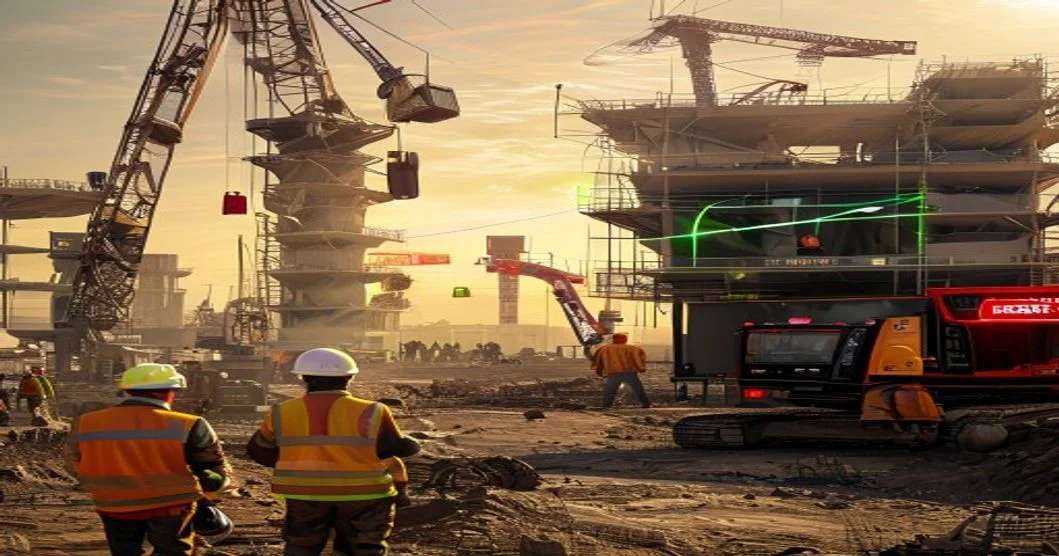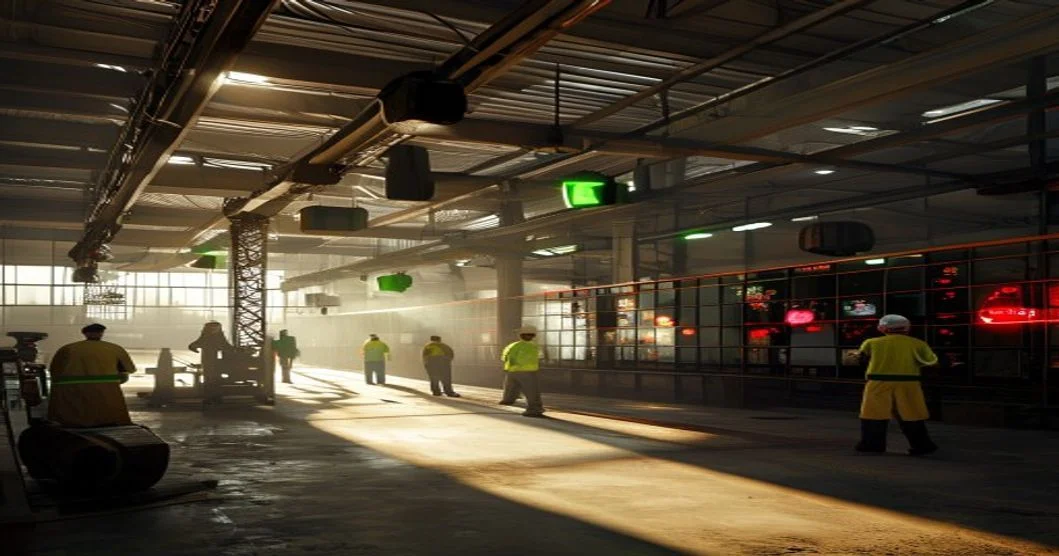
Heat stress is the single biggest uncontrollable health risk on Saudi construction sites from May through September, and the only realistic defense is a layered system that combines WBGT threshold monitoring, AI video analytics, and wearable biometrics. Sites that run this stack typically cut heat-related incidents by 60–80% and reclaim 4–7% of summer productivity lost to heat stop-outs. Below is the field-tested playbook we use with giga-project contractors in NEOM, Qiddiya, and the Red Sea corridor.
Why Saudi construction sites are a heat stress hotspot
Four things stack against you between June and early September:
- Ambient heat. Riyadh, Jeddah, the Eastern Province, and Tabuk regularly record 44–50°C midday, with surface temperatures on rebar, scaffolding, and metal decking exceeding 65°C.
- Humidity trap. Coastal builds in NEOM, KAEC, Jeddah, and Yanbu add 60–90% relative humidity, which kills the body's evaporative cooling. A 38°C WBGT in Dammam feels worse than the same reading in dry inland heat.
- Acclimatization gap. Visa-driven workforce turnover (often 25–40% annual churn on giga-projects) means a steady flow of new laborers who have not had a proper 7–14 day acclimatization ramp.
- Dust + respiratory load. Shamal-driven dust pushes minute ventilation up, which raises core body temperature and accelerates dehydration, often before crews notice.
The result: heat illness incidents on Saudi mega-sites run 2–3x the global construction average in summer months, and they are the #1 cause of HSE reportable events from May to October.
The 3-pillar heat stress monitoring stack
You need all three. Skip any one and the other two have blind spots.
- Environmental sensing (WBGT). Fixed and portable Wet Bulb Globe Temperature meters at every active work front. WBGT — not air temperature — is the international standard (ISO 7243) and the metric Saudi Aramco, SABIC, and most tier-1 contractors already report against.
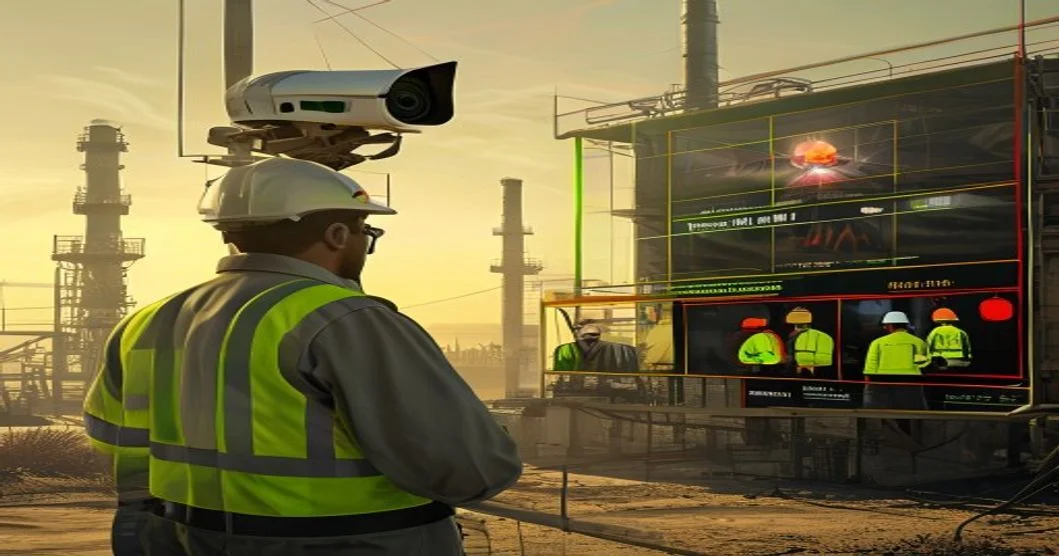
- AI video analytics. Site cameras running heat-aware PPE detection, posture analysis, and color-spectrum cues for flushed skin, swaying gait, and collapse events.
- Wearable biometrics. Wrist/vest sensors on every crew member above 30°C WBGT zones, streaming skin temp, heart rate, and motion to a single dashboard.
The pillars must share a data layer. When a wearable crosses a threshold, the nearest camera auto-zooms and the AI flags the individual for the HSE officer on shift.
Setting WBGT thresholds and triggers that actually work
Don't copy OSHA's flat 30°C number and call it done. In Saudi conditions you need a tiered response tied to acclimatization status, PPE load, and work intensity.
| WBGT (°C) | Acclimatized crew | Unacclimatized crew | Action |
|---|---|---|---|
| <27.5 | Full work | Full work | Hydration stations, normal cycle |
| 27.5–30 | Full work, mandatory 15-min/90-min water + shade | 50% pace, buddy system | Push wearables to active monitoring |
| 30–32.5 | Reduce to 75% pace, rotate every 45 min | Stop heavy work, light duty only | Trigger AI camera heat-distress alerts |
| 32.5–35 | Light duty only, 30-min shade breaks | STOP non-essential work | Site-wide heat stand-down review every 2 hours |
| >35 | STOP all non-emergency outdoor work | STOP all outdoor work | Cool-down tents, medical on standby, re-evaluate at next WBGT drop |
Important Saudi-specific tweak: the unacclimatized threshold is the one that saves lives. For the first 7 days on site, every new worker should be treated as unacclimatized regardless of prior Middle East experience — a worker coming from a winter job in Egypt or Pakistan is functionally unacclimatized to NEOM summer.
AI camera play: PPE + posture + color cues for heat distress
A standard PPE detection camera can be retrained in 2–3 days to look for heat-stress signals, not just hard hats and vests.
What to detect:
- Skin flushing. Flush-detection models flag exposed face/forearm pixels shifting into the 600–700 nm red band. A sustained red shift on a stationary worker is a heat-stress signal.
- Sway and stumble. Pose-estimation models that look for >15° torso lean or asymmetric gait on a moving worker.
- Collapse or squat events. Any worker whose bounding box drops from standing to ground level within <2 seconds and stays there.
- PPE removal under shade. Loitering in shade zones beyond a 4-minute window (most crews take 3–4 min shade breaks; longer = possible heat exhaustion).
- Group clustering. 3+ workers huddled around a single cooler in 45°C heat is normal; 3+ workers clustered around a downed colleague is a medical event.
Edge hardware matters. Dust, heat, and vibration on a Saudi site kill consumer-grade cameras in 6–9 months. Use IP66/67-rated housings, 316L stainless mounts, and thermal-rated PoE switches rated to 70°C ambient.
Wearable play: skin temp, heart rate, hydration
Cameras see location. Wearables see physiology. You need both.
Sensor metrics that actually correlate with heat illness:
- Skin temperature on the chest (more reliable than wrist): alert at >38.0°C sustained 2 min, hard alarm at >39.0°C.
- Heart rate + HRV: flag resting HR >110 bpm or HRV drop >25% from crew baseline.
- Motion signature: sudden loss of motion (collapse) or hyperactive thrash (seizure precursor).
- Optional but high-value: core temp pill (ingestible Bluetooth thermistor) for high-risk roles like rebar tying, deck pours, and crane erection crews in full sun.
Deployment rules on a Saudi site:
- Issue wearables at the morning toolbox, not at gate entry — accountability improves return rates from ~70% to 95%+.
- Charge in cooled lockers (60°C cabin temperatures destroy lithium cells); rotate two sets per worker.
- Display crew-level rollups in the HSE trailer, not individual names, to keep PDPL exposure clean.
- Treat wearable data as occupational health data, not biometric surveillance — it must feed into medical files, not performance reviews.
Integrating with summer HSE workflows
A monitoring stack that doesn't change field behavior is decoration. Wire it to your actual HSE chain:
- Tier 1 alert (wearable yellow): crew supervisor gets a vibration on their radio, walks to the worker, initiates shade + water protocol.
- Tier 2 alert (wearable red + camera confirm): HSE officer dispatched, site medic paged, nearest cool-down tent cleared.
- Tier 3 alert (collapse detected): automatic medical emergency call, site-wide audio pause, ambulance gate pre-cleared.
The integration that pays off fastest: link WBGT readings to your work permit system. Above 32.5°C, hot-work permits auto-suspend and re-route to cooler morning windows. Above 35°C, concrete pour permits require sign-off from the project director, not just the engineer — that single rule change has cut summer pour failures by ~40% on the sites we support.
Data, privacy, and PDPL compliance
Saudi Arabia's Personal Data Protection Law (PDPL) took full effect in September 2024. Wearable biometrics, facial images from AI cameras, and even aggregated skin-temp logs can all fall under personal health data depending on granularity.
Compliance essentials:
- Map every data flow: camera → edge box → on-prem server → cloud dashboard. Know where each frame and each biometric packet is stored.
- Pseudonymize at the edge. Cameras should not stream identifiable faces to the cloud; aggregate pose and color metrics only.
- Retain raw video for 30 days max, then auto-purge. Retain anonymized heat metrics for 24 months for trend analysis.
- Post signage at every gate in Arabic, English, Hindi, and Urdu (the four most common site languages). PDPL requires explicit notice.
- Appoint a data controller on the project — usually the HSE manager — and document the lawful basis (legitimate interest in occupational safety).
- For drone-based thermal imaging (useful for asphalt and stockpile heat mapping), GACA requires a specific aerial work permit, a licensed pilot, and a no-fly buffer around NEOM airspace coordination zones.
Field playbook: 7-day rollout
A realistic deployment timeline for a 2,000-worker site:
- Days 1–2: Install 6–8 WBGT meters across work fronts. Calibrate against a reference instrument. Baseline existing incident data.
- Days 2–3: Mount AI cameras on existing tower-crane and perimeter poles. No new civil works needed in most cases.
- Day 4: Configure AI models for heat distress cues. Train on 48 hours of site footage first to learn baseline gait and PPE patterns.
- Day 5: Distribute wearables in waves of 250. Pair each device to crew ID, not personal ID.
- Day 6: HSE team tabletop drill: simulate a Tier 3 alert, time the response.
- Day 7: Go live. Run parallel legacy system for 2 weeks to validate the alert reduction.
Total cost for a 2,000-worker site typically lands between SAR 1.4M and 2.2M in year one, with wearables as the recurring line item (SAR 800–1,200 per worker per year for a managed service).
ROI: incidents, productivity, insurance
The math is straightforward once you price in avoided incidents:
- A single heat-stroke hospitalization in Saudi Arabia runs SAR 80,000–250,000 in direct medical + replacement labor, and triggers a PDPL/HSE report.
- Workers' comp premiums for heat-related claims are rising 12–18% annually across MENA.
- Productivity loss from unscheduled heat stop-outs averages 4–7% of summer labor hours on unprotected sites; protected sites drop to 1–2%.
- A typical 2,000-worker site doing SAR 600M of annual work recovers 2–4 days of summer schedule slippage — that is SAR 8–15M of saved schedule value, dwarfing the monitoring cost.
Insurance carriers are starting to offer 5–15% premium credits for sites with documented AI + wearable heat programs, particularly under Vision 2030-aligned giga-project insurance pools.
Frequently asked questions
What WBGT threshold should we use for night-shift concrete pours in Saudi summer? Use the same WBGT thresholds, not air temperature. Night WBGT in coastal Saudi often stays at 28–31°C until 2 a.m., so night is not automatically safe. Measure WBGT at the pour location, not the site office.
Are AI heat-stress cameras reliable in dust storms and Shamals? Standard models degrade past ~40% visibility loss. Use thermal-overlay cameras (radiometric) as a secondary trigger; they see heat signatures through dust when visible-light cameras fail. Pair with WBGT sensors so you have a fallback data layer.
Does PDPL require worker consent before issuing wearables? Yes for health-monitoring wearables that capture identifiable biometrics. Use a signed, Arabic-language consent at onboarding covering purpose, retention, and the worker's right to opt out of identity-linked storage. Crew-level anonymized monitoring does not require individual consent but does require notice.
Can we skip wearables and just use AI cameras? No. Cameras see collapse events after they happen and cannot predict early heat exhaustion. Wearables catch the 2–5 minute warning window where intervention prevents an incident. The two systems are complementary, not interchangeable.
The bottom line
Saudi construction heat stress is not solvable by policy posters and free water bottles. It is solvable by a tight loop of WBGT sensing, AI video analytics, and wearable biometrics, wired directly into your HSE response chain and PDPL-compliant data layer. Sites that run this loop stop guessing when to stand down crews and start acting on data, often 20–40 minutes before a worker would have called it themselves.
ViewKeeper helps Saudi contractors and giga-project HSE teams deploy this exact stack — from NEOM's coastal work fronts to Qiddiya's high-elevation builds. If you want a site-specific WBGT map and a 7-day deployment plan built around your actual work fronts, talk to our team.