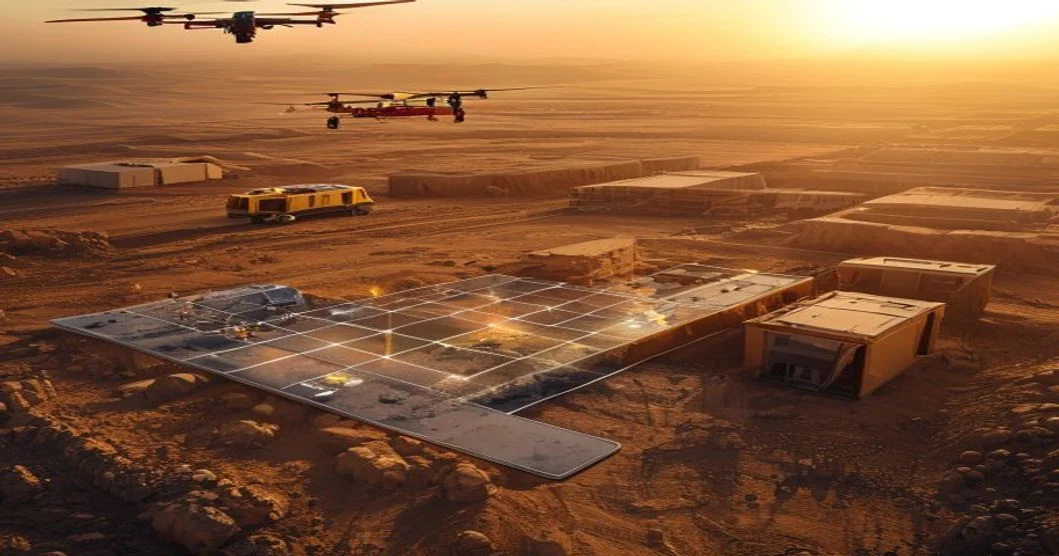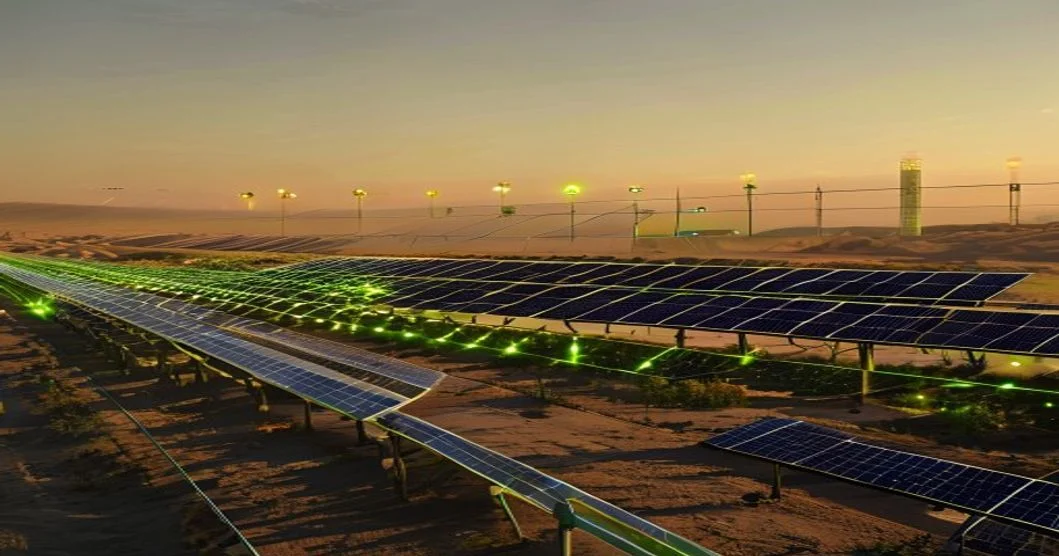
A thermal drone inspection Saudi solar farms program is the fastest way to find hotspots, bypass-diode failures, and soiling-driven losses across thousands of modules without sending crews into 50 °C heat. In a single evening flight, a properly equipped UAV can map 10–15 MW of PV, flag defective strings, and push a prioritized work order to your O&M team by morning. This playbook walks site managers and HSE leads through the physics, the cadence, and the field data we trust on Saudi utility-scale plants.
Why thermal drone inspection matters in Saudi Arabia
Saudi Arabia is building one of the densest utility-scale solar fleets on earth. The PIF pipeline alone targets roughly 40+ GW of solar by 2030, with giga-projects like NEOM, Sudair, and Shuaibah pushing modules into some of the harshest operating environments on the planet.
Three things break differently here than in temperate climates:
- Ambient cell temperature routinely hits 65–75 °C in summer. Faults that look "warm" in Europe look "catastrophic" in KSA, and the gap between a healthy module and a failing one widens.
- Dust and soiling losses run 15–25% annually if washing is delayed. Soaked dust can mask thermography or, worse, mimic hotspots when moisture evaporates unevenly after rain.
- Sand abrasion chafes junction-box potting and cable insulation, accelerating the very bypass-diode failures that thermography is best at catching.
The result: traditional annual walk-downs miss the 0.5–2% of strings that account for the majority of generation loss. A thermal drone inspection Saudi solar farms program is no longer a luxury; it is the only way to inspect 100% of modules on a quarterly cadence without burning out field teams.
How a thermal drone inspection actually works
The physics is simple. A radiometric thermal camera (FLIR Vue TZ20-R, Workswell Wiris, or DJI Zenmuse H30T) senses long-wave IR emitted by the module surface. When a cell, bypass diode, or solder joint fails, it dissipates energy as heat instead of electricity, and the anomaly shows up as a "hot" pixel relative to its string neighbors.
Critical numbers your thermographer should track:
- ΔT against the string mean — anything >10 °C is a probable failure; 5–10 °C is a watch-list item; <5 °C is noise.
- Module back vs. front — front-side flying catches cell-level defects; back-side flying catches junction-box and bypass-diode heat signatures. You want both, on different flights.
- Irradiance gate — fly only when POA irradiance is ≥600 W/m² and steady. Flights at dawn produce false negatives; flights under cloud-edge flicker produce false positives.
- Emissivity settings — 0.85 for glass, 0.95 for soiled glass, 0.70 for back-sheet. Get this wrong and every panel looks 4–6 °C cooler than reality.
A typical solar farm thermal inspection flight in KSA runs 15–20 minutes per MW block using automated mission planning, with a 30-minute battery swap and another 20 minutes for on-site QA before the crew moves to the next block.
The 7 hotspots you actually find in KSA conditions
After surveying several million modules across Saudi Arabia and the wider GCC, the fault distribution is remarkably consistent:
- Bypass diode failure (short or open) — the single biggest defect class, often 30–40% of all findings. Diodes short when junction boxes overheat; they open when thermal cycling cracks the solder. Both show as a full third of a string running 15–25 °C hotter than its twin.
- Cell cracks and snail trails — sand loading and thermal shock create micro-cracks that propagate. Visible in IR as finger-shaped hot lines.
- Soiling hotspots — bird droppings, cement dust, and oil spots create localized soiling that mimics a real cell fault. Confirmed by visual + IV curve tracing.
- Junction-box heating — loose MC4 connectors and degraded potting. Often the precursor to arc faults and the #1 fire risk in hot climates.
- PID (potential-induced degradation) — module-level hot patterns on the negative-polarity end of long strings. Very common on systems over 4 years old in humid coastal sites like Jeddah or Rabigh.
- Substring open-circuit — a single module in bypass; the rest of the string runs normally. Easy to miss in walk-downs, trivial in aerial thermography.
- Combiner-box and DC string cabling — the under-appreciated half. Aerial substation thermal inspection drone work catches loose busbars, fuseholder heating, and inverted-polarity strings that ground crews can take hours to find.
The cheapest defect on that list to fix is the one you find in week 2, not month 8.
Bypass diode failure: the silent string killer
If you take one thing from this guide, take this: bypass diode failure thermal imaging is the single highest-ROI use of a drone on a Saudi PV plant.
A single shorted diode can drag down a 24-module string by 8–12% for months before anyone notices. Multiply that across hundreds of strings, and you are donating 0.5–2% of your annual generation to heat. On a 100 MW plant at current Saudi industrial PPAs, that is real money — seven figures of revenue per year.
The signature is unmistakable in thermography: a contiguous block of exactly 8 cells (in a typical 72-cell module with 3 diodes) running 15–30 °C hotter than the surrounding string. Healthy modules in a healthy string should sit within ±2 °C of each other across the array.
A drone-based diode audit on a 50 MW site typically runs 2 nights of flying and identifies 150–400 defective modules that would have cost the asset owner 1.5–3 GWh of lost generation before the next scheduled maintenance.
Inspection cadence for Saudi sites
The right cadence is not "annual." Saudi heat, dust, and humidity compress defect rates in ways that surprise European-trained O&M teams. Our recommended program:
| Inspection type | Frequency | Best window (KSA) | Coverage | Typical finding rate |
|---|---|---|---|---|
| Quarterly thermal drone survey | 4×/year | March, June, Sept, Nov | 100% of modules | 0.8–1.5% of modules flagged |
| Post-dust-storm event survey | Ad-hoc | Within 7 days of shamal | 100% of modules | 0.3–0.6% new findings |
| Annual full IV curve + EL | 1×/year | Dec–Feb (cool, stable) | Sampled 1–2% | Hidden cell cracks |
| Weekly visual (drone RGB) | Weekly | Year-round | 100% | Soiling %, security, vegetation |
| Substation thermal drone | 2×/year | Pre-summer, post-summer | 100% of MV equipment | 5–15 hot joints per site |
The key insight: utility-scale solar drone survey work is not a one-time event. The second and third flights catch the progression of faults — the module that was 7 °C warm in March is now 14 °C warm in June, and is one thermal cycle away from a bypass event.
Field data: what thousands of panels taught us
Across the last 12 months of ViewKeeper deployments on Saudi PV assets, a few patterns are hard to argue with:
- The top 5% of hottest modules account for 60% of recoverable loss. Fix the worst 5% of strings and you recover more generation than re-washing the entire site.
- Diode failures cluster by combiner box, not randomly. If you find two failed diodes in one combiner, the rest of that combiner has a 3–4× higher probability of failure within 6 months. Replace the whole box's diodes proactively.
- Soiling-adjusted thermography changes the picture by ~20%. Without a soiling map, you over-flag clean panels with dirty neighbors. ViewKeeper fuses RGB and IR to separate real thermal faults from dust shadows.
- Drone-vs-manual thermography coverage gap is roughly 12:1. A 4-person manual thermography crew covers 1–1.5 MW per night. A 2-person drone crew covers 12–18 MW per night with higher spatial accuracy.
- Mean time to repair after a drone finding: 9 days vs. 47 days for a manually found defect. Speed is the whole point.
Compliance: GACA airspace, PDPL data, and Vision 2030
Three Saudi-specific rules shape how you should plan a thermal drone inspection Saudi Arabia program:
- GACA airspace authorization. All commercial UAV work requires a GACA operator permit (SfOC) and a site-specific NOTAM. Solar plants in controlled airspace near airports (common around Riyadh, Jeddah, Dammam) need additional coordination. Plan 10–15 working days for first-time permits at a new site.
- PDPL data handling. Radiometric thermal imagery can incidentally capture personnel and is classed as personal data under Saudi Arabia's Personal Data Protection Law. Flight planning must include geo-fencing of inhabited areas, blurred exports, and an auditable data-retention policy (typical default: 90 days raw, indefinite anonymized). ViewKeeper's default pipeline hashes faces and license plates before delivery.
- Vision 2030 and local content. Localization requirements (Saudization, in-kingdom data hosting) increasingly show up in EPC RFPs. Operating with a GACA-licensed Saudi crew, in-kingdom image processing, and Arabic-language deliverables is now a bidding requirement on most SEC and SWCC solar tenders.
Frequently asked questions
How much does a thermal drone inspection cost per MW in Saudi Arabia? For utility-scale plants, all-in pricing typically lands between SAR 800–1,400 per MW per flight (roughly USD 215–375), depending on site accessibility, reporting depth, and whether substation and DC string thermal work is bundled. The cost of a missed bypass-diode failure on a 100 MW plant usually exceeds the entire annual inspection budget.
When is the best time of year to fly thermography in KSA? Aim for the March–April and October–November windows for full surveys: high irradiance (>700 W/m²), low humidity, and moderate ambient temperatures (30–38 °C) minimize false readings. Mid-summer flights are still useful for trend analysis but expect 10–15% more false positives from genuinely hot but healthy modules.
Can drones inspect the DC string cabling and combiner boxes, or only the modules? Both. A separate flight with the UAV hovering 3–5 m above combiner boxes and walking the DC cabling captures loose connections, hot fuses, and undersized lugs. Many asset owners bundle this with a substation thermal inspection drone survey of the MV switchgear and inverter transformers for a full electrical health snapshot.
Do I need a GACA permit for every flight, or just once per site? You need both. A blanket GACA operator permit covers the company, but each site requires a separate airspace authorization and a daily NOTAM. Expect 5–7 working days for a renew, 10–15 for a brand-new site. ViewKeeper handles both as part of the standard mobilization.
The bottom line
A mature thermal drone inspection Saudi solar farms program pays for itself the first time it catches a 24-module bypass-diode failure in week 2 instead of month 8. The pattern is consistent across every site we fly: a small fraction of strings is responsible for a disproportionate share of lost generation, and quarterly thermography is the cheapest way to find them before the next dust storm, heat wave, or curtailment window compounds the loss.
If you want a partner that already holds a GACA permit, processes imagery in-kingdom, and delivers a PDPL-compliant defect report within 72 hours of takeoff, talk to ViewKeeper. We staff Saudi-licensed pilots, fly radiometric payloads matched to your module count, and hand you a work order your O&M team can execute the same week — not the same quarter.